How Indexing Issues Impact Your SEO Performance
If your traffic has flatlined even though you keep publishing content, the problem might not be your writing at all. It might be that Google never indexed the page in the first place. How indexing issues impact your SEO is one of the most overlooked problems in digital marketing, because everything can look fine on the surface while your pages are effectively invisible to search engines.

TABLE OF CONTENTS
What Does It Mean When a Page Isn't Indexed
Indexing is the process where Google crawls a page, reads its content, and stores it in the massive database it pulls search results from. A page that isn't indexed cannot rank, cannot show up in search, and cannot send you a single visitor, no matter how good the content is or how many keywords you targeted.
This is different from a ranking problem. A page that ranks poorly is at least in the game. A page that isn't indexed doesn't exist as far as Google's results are concerned. Site owners often assume they have a content quality issue when really they have a technical access issue, and those two problems require completely different fixes.
The Most Common Causes of Indexing Problems
Most indexing issues trace back to a handful of technical mistakes that are easy to make and easy to miss. Here's what we typically find when we run an SEO audit for a new client.
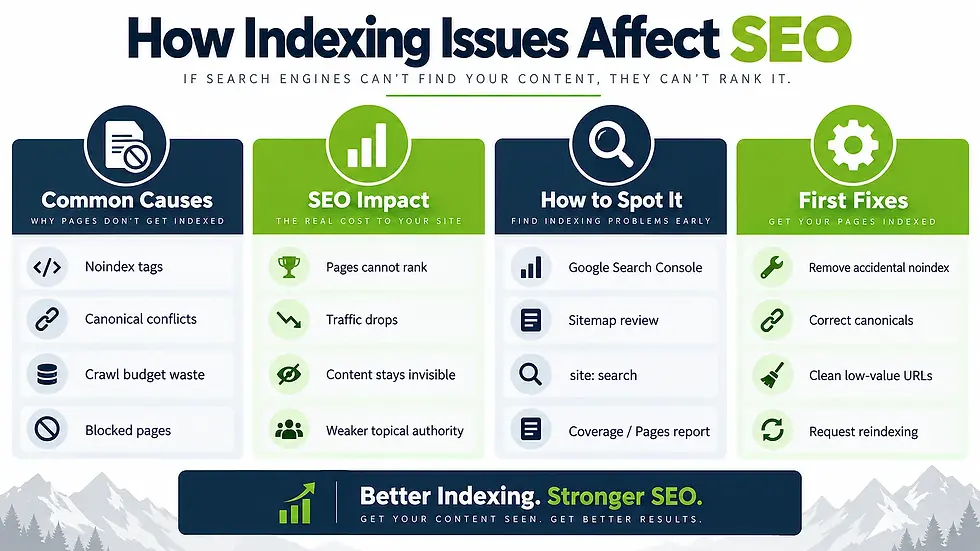
Noindex Tags Left in Place After Launch
Developers often add a noindex tag to a site during staging so search engines don't crawl an unfinished build. That tag is supposed to be removed before launch, but in practice it gets left behind more often than people expect. We've walked into audits where an entire site had been live for months with a noindex tag quietly blocking every page from search results.
Crawl Budget Waste on Low Value Pages
Google allocates a limited crawl budget to every site, meaning its crawlers only spend so much time and resources on your domain before moving on. If that budget gets eaten up by thin filter pages, duplicate parameter URLs, or old paginated archives, your important pages can get crawled less often or missed entirely. Larger sites with ecommerce filters or tag archives run into this constantly.
Broken or Conflicting Canonical Tags
A canonical tag tells Google which version of a page is the "real" one when duplicates exist. When canonical tags point to the wrong URL, point to a page that no longer exists, or contradict each other across templates, Google can end up indexing the wrong version of a page or skipping it altogether.
How Indexing Issues Impact Your SEO Rankings and Traffic
The impact is direct and often severe. If a page isn't indexed, it contributes zero organic traffic, zero rankings, and zero visibility in AI answer engines like ChatGPT or Perplexity, which increasingly pull from the same indexed content Google relies on. Every dollar spent creating that page becomes a sunk cost until the indexing problem is fixed.
There's also a compounding effect that people miss. Search engines use indexed pages to understand the full scope of a site's authority on a topic. When key pages are missing from the index, it weakens the topical relevance of pages that are indexed, because the overall content cluster looks smaller and less complete than it actually is. In client audits, we've seen sites recover double digit percentage traffic gains within weeks simply from re-indexing pages that had been silently excluded for months.
How to Spot Indexing Problems Before They Cost You Traffic
Catching indexing issues early comes down to checking the right signals on a regular basis rather than waiting for traffic to drop. A quarterly review is the minimum; monthly is better for larger or fast-changing sites.
Start with Google Search Console and look at the Pages report under the Indexing section. This shows you exactly which URLs are indexed, which are excluded, and the specific reason for each exclusion. Cross-reference that list against your actual sitemap so you can spot pages that should be indexed but aren't showing up.
It also helps to periodically search site:yourdomain.com in Google to get a rough sense of what's actually indexed compared to what you expect to see. This isn't a precise tool, but a wildly low number compared to your total page count is a strong early warning sign worth investigating further.
Why Is SEO So Important When Indexing Is Broken
SEO strategy only works if the foundation underneath it is sound, and indexing is that foundation. You can write excellent content, build strong backlinks, and optimize every on-page element, but none of it matters if the page never makes it into the index. This is why is SEO so important as a discipline that goes beyond keywords and content calendars into technical maintenance most businesses never think about.
A digital marketing agency that only focuses on content and ignores the technical layer is leaving real growth on the table. The best SEO strategists treat indexing health as a recurring maintenance task, not a one time setup step, because sites change constantly and new indexing problems can appear with every redesign, migration, or plugin update.

How Wasatch Digital Group Approaches Indexing Audits
Wasatch Digital Group treats indexing health as a core part of every SEO audit we run, not an afterthought bolted on at the end. As a Utah SEO company working with clients across the country, we've found that indexing problems are one of the most common reasons a site underperforms despite having decent content, and they're also one of the fastest issues to fix once identified. Our process pulls data directly from Google Search Console, cross-checks it against your sitemap and crawl logs, and flags noindex tags, canonical conflicts, and crawl budget waste before they quietly cost you traffic.
If you suspect your site has pages that search engines simply can't see, it's worth having a search engine marketing agency take a real look under the hood. Wasatch Digital Group offers indexing audits as part of our broader SEO services, giving you a clear picture of what's actually happening behind the scenes and a straightforward plan to fix it. Contact us today to learn more.


Comments