How Long Does SEO Take and What Affects It
- Apr 21
- 6 min read
If you've ever invested time or money into SEO and found yourself wondering "when is this actually going to work?", you're not alone. It's one of the most common questions business owners ask, and honestly, the answer can be a little frustrating at first. SEO is not a light switch you flip and watch the traffic pour in overnight. It's more like planting a garden — you put in the work, tend to it consistently, and results build over time.
That said, there's a lot more nuance to the timeline than just "it takes time." Several factors influence how quickly you'll see results, and understanding them can help you set realistic expectations and make smarter decisions for your business.

Table of Contents
Why SEO Takes Time
Before diving into timelines, it helps to understand what SEO actually involves. Search engine optimization is the process of improving your website so that search engines like Google rank it higher in search results. But Google doesn't just look at one thing — it evaluates hundreds of signals, including your site's content, its technical health, how other websites link to it, and how users interact with it.
When changes are made to a website, Google needs time to crawl those pages, index them, and re-evaluate where they should rank. That process alone can take weeks. Then, once your pages are indexed, it takes additional time to accumulate the engagement signals — click-through rates, time on page, return visits — that push rankings higher.
This is why is SEO so important to start sooner rather than later. The earlier you build your foundation, the sooner the momentum compounds.
How Long Does SEO Take to Show Results
Most SEO specialists agree that you can expect to see meaningful results somewhere between three and twelve months, depending on your starting point and goals. For brand-new websites, it often takes longer because you're starting from scratch with no domain authority, no existing content, and no backlinks. For established websites that already have some online presence, changes can produce noticeable movement more quickly.
That said, "results" can mean different things. You might see your rankings improve in the first couple of months, traffic increases by month four or five, and significant lead or revenue growth by month six to twelve. Progress is rarely linear, and some keywords will move faster than others based on competition and search volume.
Key Factors That Affect Your SEO Timeline
Your Website's Age and History
Google tends to trust older domains that have a track record of quality content and legitimate link-building. A website that's been around for five years will often rank faster for new content than one that launched six months ago. If your domain has any history of spammy tactics or penalties, that can also slow things down considerably.
Competition in Your Industry
The more competitive your industry, the longer it typically takes to rank. If you're a local business going after niche keywords in a smaller market, you may see results faster than a national company trying to rank for broad, high-volume terms. Working with an experienced SEO strategist helps identify the right mix of competitive and attainable keywords for your specific situation.
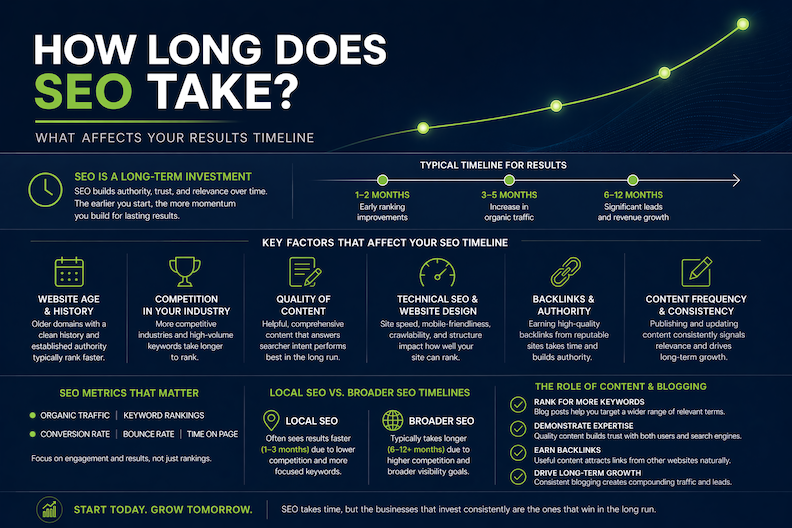
Quality of Your Content
Content is one of the biggest drivers of SEO performance. SEO friendly content isn't just about stuffing keywords into a page — it's about genuinely answering the questions your audience is searching for, in a clear and organized way. Pages that are thin, outdated, or poorly written tend to get pushed down in favor of more comprehensive, useful content. Google's own guidelines make it clear they prioritize content that is helpful, accurate, and created for people first.
Technical SEO and Website Design
Even great content can underperform if your site has technical problems. Site speed, mobile responsiveness, crawlability, and proper URL structure all play a role in how well your site performs. If web designers haven't optimized the technical architecture of your site, you may be leaving rankings on the table regardless of how good your content is. A solid website design isn't just about looks — it's a core part of your SEO strategy.
Backlinks and Authority
Backlinks — links from other websites pointing to yours — are one of the most powerful ranking signals Google uses. Earning high-quality backlinks from reputable sources takes time and consistent effort. You can't rush this process without risking penalties, which is why working with a reputable digital marketing agency matters. Shortcuts like buying links or using link farms can do serious long-term damage to your rankings.
How Frequently You Publish and Update Content
Websites that consistently add new, relevant content tend to perform better over time. Blogging for business is one of the most effective long-term strategies for improving SEO because it helps you rank for a wider range of keywords, demonstrates expertise, and gives other sites something worth linking to. Consistent publishing signals to Google that your site is active and relevant.
SEO Metrics That Matter
Once you're investing in SEO, knowing which numbers to watch helps you understand whether things are moving in the right direction. The SEO metrics that matter most include:
Organic traffic — the number of visitors coming to your site through unpaid search results — is the big one. Keyword rankings tell you where your pages appear for specific search terms, but they're a leading indicator, not the end goal. Conversion rate, bounce rate, and time on page help paint a picture of whether your traffic is actually engaging with your content. And domain authority, while not a Google metric, is a useful proxy for understanding how well your site stacks up against competitors. Setting up Google Search Console and Google Analytics from the start gives you a clear baseline to measure progress against over time.
Local SEO vs. Broader SEO Timelines
If you're a business serving a specific geographic area, local SEO deserves its own focus. Local SEO refers to optimizing your online presence to attract customers in a specific location — things like your Google Business Profile, local citations, and location-specific content on your website.
The good news is that local SEO often shows results faster than broader, national-level campaigns. There's less competition, and Google gives significant weight to proximity and relevance for local searches. If someone near you types "website designer near me" or searches for a Utah SEO company, local SEO is what helps you show up. Optimizing for local search alongside social media marketing can be a powerful combination for driving foot traffic and inquiries.
Blogging for Business and Content's Role in SEO
One of the most underrated SEO investments a business can make is a consistent blogging strategy. Blogging for business isn't about writing for the sake of writing — it's about strategically creating content that answers real questions your potential customers are searching for.
Each blog post is an opportunity to rank for a new keyword, build topical authority in your industry, and earn backlinks from other sites. Over time, a well-maintained blog becomes one of your most valuable marketing assets. It works for you around the clock, drives organic traffic, and supports every other piece of your digital marketing strategy.
Search engine marketing agency partners will often recommend blogging as one of the first content strategies to implement because the return on investment grows over time. A post you write today could be driving traffic and leads two years from now.
How Wasatch Digital Group Approaches SEO
SEO is a long game, but it doesn't have to be a confusing one. At Wasatch Digital Group, we help businesses cut through the noise and build SEO strategies that are grounded in data, focused on real results, and designed to grow with you over time. Whether you're just getting started or looking to improve what you've already built, our team is here to help.
Ready to see what's possible? Explore our SEO services and reach out to the team at Wasatch Digital Group to start a conversation about your goals. We'd love to help you build something that lasts.


Comments