What Google Says About AI Content and SEO
If you've been following the conversation around AI content and SEO, you've probably noticed that there's a lot of noise out there. Some people swear AI content will tank your rankings. Others say it's the future of content marketing. So what does Google actually say? That's what we're here to break down.

Table of Contents
Does Google Allow AI Content?
The short answer is yes. Google has made it clear that AI-generated content is not inherently against their guidelines. In a 2023 statement from Google Search Central, the search engine confirmed that it rewards high-quality content regardless of how it was produced. The key phrase there is "high-quality." Google isn't asking whether a human or a machine wrote your content. It's asking whether your content is helpful, accurate, and trustworthy.
This is a meaningful shift from earlier assumptions. For years, the SEO community operated under the belief that AI content was automatically risky. But Google's own guidance tells a different story. Their focus has always been on quality and intent, not the production method.
That said, "Google allows AI content" doesn't mean anything goes. There's still a clear line between content that serves the reader and content that exists purely to manipulate search rankings. Google is very good at spotting the latter, and that's where the real risk lies.
Does Google Penalize AI Content?
This is the question everyone wants a straight answer to, and here it is: Google does not penalize AI content simply because it's AI-generated. What they do penalize is content that is low quality, spammy, or designed to game the algorithm rather than genuinely help a reader.
Google's spam policies specifically call out "automatically generated content" that lacks value as a violation. But the operative word is value. A well-researched, carefully edited piece of content that happens to use AI tools in the production process is not in violation of anything.
The nuance matters here. Google's guidance draws a distinction between AI content used to create genuinely helpful information versus AI content used to flood the web with thin, repetitive pages that serve no one. The former is acceptable. The latter is not.
What About AI Content Spam?
Google's Helpful Content System, which was first introduced in 2022 and has since been incorporated into its core algorithm, is specifically designed to identify and downrank content that feels unhelpful or written for search engines rather than people. AI content that is poorly edited, factually questionable, or doesn't add anything new to a conversation is exactly what this system targets. If you're producing AI content at scale without review or editorial judgment, that's where you're likely to run into trouble. Not because it's AI content, but because it's bad content.
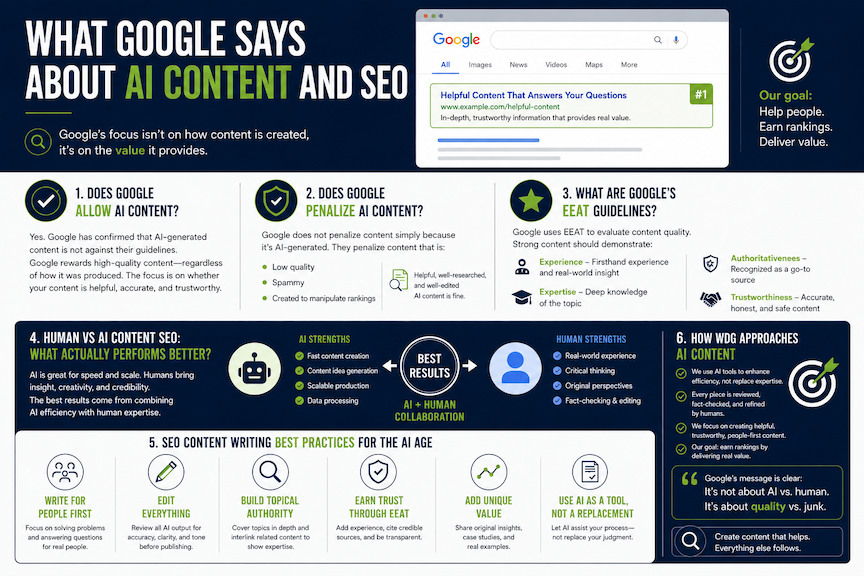
What Are Google's EEAT Guidelines?
EEAT stands for Experience, Expertise, Authoritativeness, and Trustworthiness. These are the signals Google uses to evaluate whether content deserves to rank well. Understanding the EEAT Google guidelines is essential for anyone developing a content optimization strategy, whether you're using AI or not.
Here's a quick breakdown of what each pillar means in practice:
Experience: Has the author actually encountered the topic firsthand? Personal insight and real-world experience carry weight.
Expertise: Does the content demonstrate a genuine understanding of the subject matter?
Authoritativeness: Is the source recognized within its industry or niche?
Trustworthiness: Is the information accurate, properly cited, and honest about its limitations?
AI content, on its own, struggles to check the "experience" box authentically. That's why purely AI-generated content without human editing and perspective often falls flat in EEAT evaluations. The fix isn't to abandon AI. It's to layer human insight on top of it.
Human vs AI Content SEO: What Actually Performs Better?
The human vs AI content SEO debate often gets framed as an either/or situation. In reality, the most effective approach for most businesses is a hybrid one.
AI tools are genuinely useful for generating first drafts, identifying content gaps, and scaling production. But they don't have opinions, they can't draw from lived experience, and they're not always accurate. Human writers and editors bring the credibility, nuance, and fact-checking that AI lacks.
From an SEO performance standpoint, content that combines AI efficiency with human judgment tends to perform better than content produced entirely by either alone. AI can help you cover more ground. Human review ensures that ground is worth covering.
A study by Search Engine Journal found that the quality of AI content varied significantly based on how much human editing was applied post-generation. Heavily edited AI content often performed comparably to fully human-written content. Unedited AI content, not so much.
SEO Content Writing Best Practices for the AI Age
Whether you're leaning into AI tools or writing everything from scratch, these SEO content writing best practices apply across the board.
Write for People First
Google's own documentation repeatedly emphasizes this point. Before you think about keywords, think about whether your content genuinely answers a question or solves a problem for a real person. If it does, you're off to a good start.
Edit Everything, Always
No AI output should go live without human review. Check for factual accuracy, tone consistency, and whether the piece actually delivers on what it promises in the headline.
Build Author Credibility
If EEAT matters to your rankings (and it does), make sure your content is associated with credible authors. Author bios, linked profiles, and bylines on relevant credentials all signal authority to Google.
Use Internal and External Links Strategically
Linking to authoritative external sources and to your own relevant content helps Google understand the context of your pages. It also builds trust with readers who want to verify what they're reading.
Don't Neglect Technical SEO
Great content on a slow or poorly structured website won't perform the way it should. Content and technical SEO work together, not in isolation.

What Google Says About AI Content: How Wasatch Digital Group Approaches It
At Wasatch Digital Group, we've spent a lot of time thinking about how to use AI responsibly within a content strategy that holds up to Google's standards. Our approach centers on using AI as a tool, not a replacement for strategy and editorial judgment. Every piece of content we help produce is reviewed, refined, and shaped around the specific goals of the business it represents.
If you're not sure whether your current content strategy is keeping up with what Google expects, we're here to help. Explore our services to see how we can support your SEO and content goals, and contact our team to start a conversation about what's working, what's not, and what's next.


Comments