What is E-E-A-T? Here's What Every Business Owner Should Know
If you have spent any time reading about SEO, you have probably run into the letters E-E-A-T and wondered what they actually mean for your website. It stands for Experience, Expertise, Authoritativeness, and Trust, and it is the framework Google uses to judge whether content is genuinely helpful or just filler. Understanding what is E-E-A-T and how it applies to your business can change the way you write blogs, build your website, and think about your brand online.

Table of Contents
What Does E-E-A-T Actually Stand For
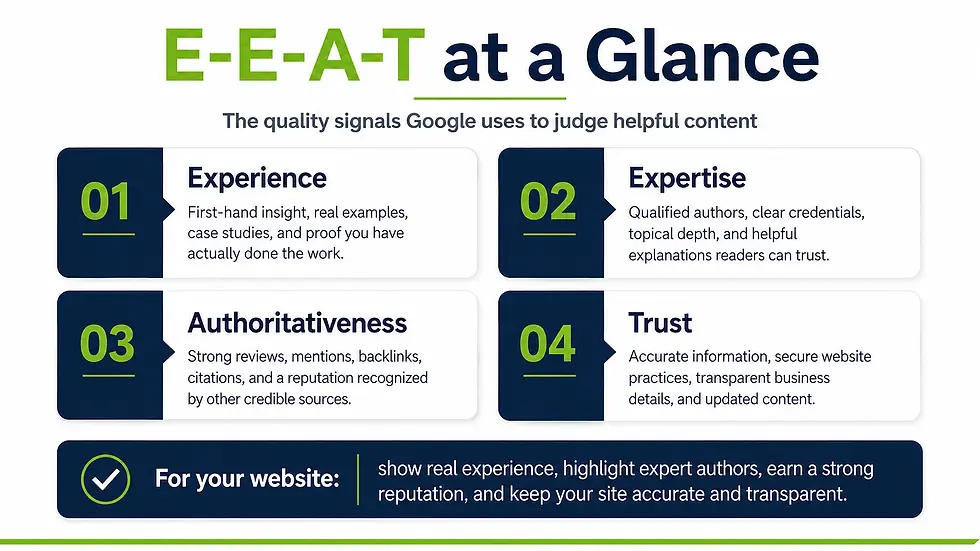
Each letter represents a quality Google's human quality raters look for when they review search results. Experience means the content was created by someone who has actually done the thing they are writing about, not just researched it secondhand. Expertise means the person has real knowledge or skill in the subject. Authoritativeness means other credible sources recognize the site or author as a reliable voice in that space. Trust ties everything together, covering whether the content is accurate, the site is secure, and the business is transparent about who it is and what it offers.
E-E-A-T started as E-A-T back in 2014, and Google added the second E for Experience in 2022 to account for content written by people with hands-on, lived knowledge of a topic. It is worth noting that E-E-A-T is not a direct ranking factor you can check off a list. It is a set of quality signals baked into how Google evaluates whether your content deserves to rank well and be shown to searchers. If you want to see how Google explains this framework in its own words, the concept is spelled out in the Search Quality Rater Guidelines, the public document Google uses to train the human raters who help evaluate search quality.
Why This Framework Matters for Rankings
Google's entire business depends on people trusting its search results. If searchers start finding thin, inaccurate, or misleading pages at the top of the results, they stop trusting the search engine and go elsewhere. This matters even more for topics that affect someone's health, finances, or safety, which Google groups under the label Your Money or Your Life. Pages on these topics are held to a much higher standard because the cost of bad information is higher too.
Even outside of YMYL topics, E-E-A-T shapes how Google's systems separate content that was clearly written to rank from content that was written to genuinely help a reader. A blog post stuffed with keywords but light on real insight tends to underperform compared to a shorter, plainer post written by someone who actually knows the subject.
What is E-E-A-T? A Look at It in Practice
What is E-E-A-T? Strip away the jargon, and it is really about applying those four quality signals to an actual website. Think about a local plumbing company writing a blog post about water heater repair. A page with real photos from actual jobs, a few notes about mistakes to avoid based on years in the field, and a clear author bio signals experience and expertise in a way that generic advice copied from somewhere else never will. Add a few mentions in local publications or a strong set of Google reviews, and you start checking the authoritativeness and trust boxes too.
This is where digital marketing and SEO best practices overlap with everyday good business sense. Publishing helpful blogs, keeping your website accurate and updated, and being upfront about your services all feed directly into how Google, and honestly how your customers, perceive you. Readers can usually tell within a few seconds whether a page was written by someone who understands the subject, and Google's systems are getting better at spotting the difference too.
How to Build Stronger E-E-A-T Signals
Building E-E-A-T is not a single project you finish and move on from. It is a habit built into how you create content and run your website over time.
Show Real Experience
Use real photos, real case studies, and specific details from your own work. A contractor describing an actual job site, or a consultant walking through a real client scenario, communicates experience far better than generic descriptions ever could.
Highlight Expertise and Credentials
Include author bios with relevant background, certifications, or years in the field. If someone on your team has genuine expertise, let readers know who wrote the content and why they are qualified to write it.
Earn Authority Through Mentions and Links
Getting mentioned by respected local organizations, industry associations, or news outlets tells Google that other credible sources vouch for you. This often grows naturally out of good local SEO work, community involvement, and consistent public relations effort.
Build Trust With Accuracy and Transparency
Keep your information current, cite sources when you reference data, and make sure your contact information, privacy policy, and business details are easy to find. A secure, well-maintained website with clear ownership information signals trust before a visitor even reads your content.
Common Mistakes Small Businesses Make
A lot of small business websites lose ground here without realizing it. Thin blog posts published just to hit a publishing schedule, missing or vague author information, and copywriting that reads like it was written by no one in particular are common culprits. So is letting old blog posts sit untouched for years after the information in them has changed.
Another mistake is treating content creation purely as a numbers game, publishing as many blogs as possible without putting real thought into keyword research or the questions your actual customers are asking. Quality and relevance tend to matter more than volume, especially as Google's systems get better at recognizing content written to genuinely help someone versus content written just to fill a page.

How Wasatch Digital Group Helps With E-E-A-T
At Wasatch Digital Group, this is the kind of work we do every day for businesses across Utah and beyond. We help clients build out author profiles, plan blog content around real keyword research, strengthen local SEO through reviews and citations, and write copy that sounds like it came from a real person who knows the business. E-E-A-T is not something you fix in a single afternoon, but small, consistent improvements add up.
If you want a partner to help sort through where your website stands and what to prioritize next, our team offers services built around exactly this kind of work. From content creation and copywriting to local SEO strategy, we focus on the details that help your site earn trust with both readers and search engines. Contact us today to learn more.


Comments